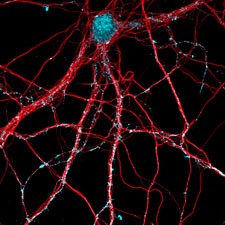
Amyloid beta (cyan blue) binds to nerve
cells of the hippocampus (red) and attacks synapses resulting in the loss of
memories in Alzheimer’s disease. New research has led to important insights into the
mechanisms that induce synapse loss. The discovery brings hope for the
development of new therapies that protect synapses and therefore prevent memory loss in Alzheimer’s disease.
Antibodies that block the process of synapse disintegration in Alzheimer's disease have been identified, raising hopes for a treatment to combat early cognitive decline in the disease. Alzheimer's disease is characterized by abnormal deposits in the brain of the protein Amyloid-ß, which induces the loss of connections between neurons, called synapses. Now, scientists at UCL have discovered that specific antibodies that block the function of a related protein, called Dkk1, are able to completely suppress the toxic effect of Amyloid-ß on synapses. The findings are published today in the Journal of Neuroscience. Professor Patricia Salinas (UCL Department of Cell & Developmental Biology) who led the study, said: "These novel findings raise the possibility that targeting this secreted Dkk1 protein could offer an effective treatment to protect synapses against the toxic effect of Amyloid-ß. "Importantly, these results raise the hope for a treatment and perhaps the prevention of cognitive decline early in Alzheimer's disease." Dkk1 is elevated in the brain biopsies of people with Alzheimer's disease but the significance of these findings was previously unknown. Scientists at UCL have found that Amyloid-ß causes the production of Dkk1, which in turn induces the dismantling of synapses (the connections between neurons) in the hippocampus, an area of the brain implicated in learning and memory.
TO READ THIS ARTICLE, CREATE YOUR ACCOUNT
And extend your reading, free of charge and with no commitment.