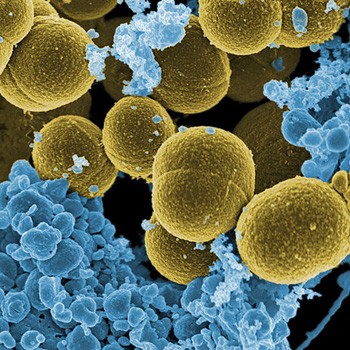
Staphylococcus aureus bacteria (yellow) escape destruction by human white blood cells. Source: Wikimedia Commons
An international team of scientists has uncovered the structure of the protective protein coat which surrounds many bacteria like a miniature suit of armour. Their research and could help us develop new vaccines. Until now, scientists have known very little about the structure and function of this coat, which scientists call S-layer, despite the fact that some bacteria invest as much as a third of their total protein production in building it. The team of scientists, funded in the UK by the Biotechnology and Biological Sciences Research Council, were able to image the S-layer of a harmless soil bacterium called Geobacillus stearothermophilus down to the scale of a single atom. They revealed that the individual proteins of the protective layer hook together much like the chainmail of a medieval knight. Stefan Howorka (UCL Chemistry) led the work in the UK. He explains "These protein coats have remained quite mysterious to scientists even though they are found on a huge variety of bacteria.
TO READ THIS ARTICLE, CREATE YOUR ACCOUNT
And extend your reading, free of charge and with no commitment.