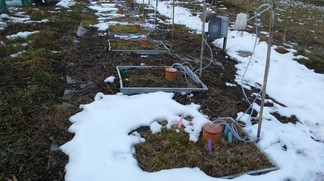
Researchers are studying the effects of climate change on the degradation of organic matter in the soil. First results underline the importance of the thermal insulation provided by an intact layer of snow on the dynamics of soil microorganisms. You'd think that during the winter, all life trapped beneath a layer of snow would shut down and wait for warmer days. Think again! A thick uncompressed snow cover can act as an insulating blanket, keeping the underlying turf warm and the resident microorganisms happy - and active. Just how active they are, what they are doing, and how they would respond to a shift towards a warmer, drier climate are questions that Hermine Durand, a Master's student from the Ecole Normale Supérieure in Paris, and Konstantin Gavazov, a PhD candidate from the Ecological Systems Laboratory (ECOS) are currently addressing. "We already know that lignin and cellulose, the hard to digest components of organic matter found in soils, are decomposed during the winter months," explains Gavazov. But due to the difficulty of studying the behavior of plants and microbial communities under a snow cover, only very little research has focused on carefully characterizing soil respiration under these conditions. Soil respiration involves the degradation of organic matter present in the soil and the release of CO2 into the atmosphere. "It is important to distinguish between autotrophic and heterotrophic respiration," explains Professor Alexandre Buttler, head of the ECOS lab. During the summer months, the majority of the released CO2 is autotrophic, stemming from a plant's own metabolism. But during the winter months, heterotrophic respiration - the decomposition of organic matter in the soil by microorganisms, and the subsequent release of CO2 into the atmosphere - takes over. Simulating climate change in the field
TO READ THIS ARTICLE, CREATE YOUR ACCOUNT
And extend your reading, free of charge and with no commitment.
Your Benefits
- Access to all content
- Receive newsmails for news and jobs
- Post ads