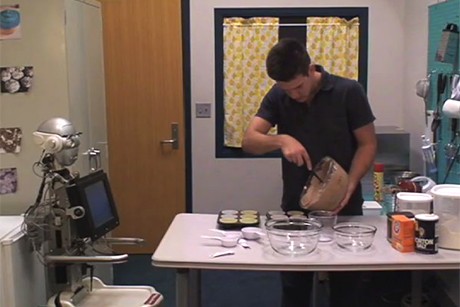
Provided
Before long, robots will be giving us helpful advice, but we don't want them to be snippy about it. Research at Cornell and Carnegie Mellon universities suggests that if they sound a little less sure of themselves and throw in a few of the meaningless words humans are fond of, listeners will have a more positive response. "People use these strategies even when they know exactly," explained Susan Fussell, associate professor of communication. "It comes off more polite." The study, "How a Robot Should Give Advice," was conducted at Carnegie Mellon while Fussell was teaching there, and reported at the Eighth Annual ACM/IEEE Conference on Human-Robot Interaction, March 3-6, 2013 in Tokyo. Co-authors are Sara Kiesler, the Hillman Professor of Computer Science at Carnegie Mellon, and former graduate student Cristen Torrey, now at Adobe Systems. Giving advice can be tricky, because it can be seen as "face-threatening." You're saying in effect that the advisee is not smart. The best approach, the researchers suggest, is for the adviser not to claim to be all that smart either, and to use informal language.
TO READ THIS ARTICLE, CREATE YOUR ACCOUNT
And extend your reading, free of charge and with no commitment.