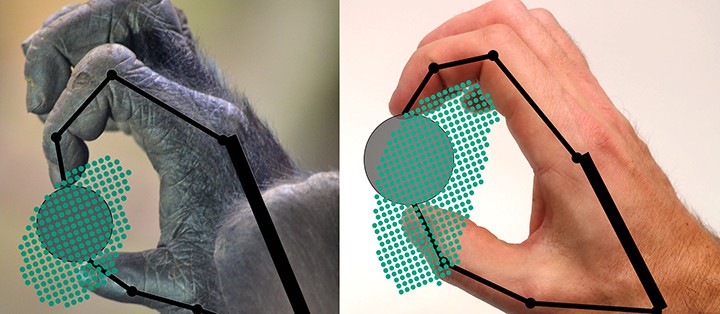
This figure shows samples of the ability of a gorilla and a human to grip and move an object. The kinetic model estimates the ability to grip and manipulate a circular object. The dots indicate positions in which the object can be gripped.
Scientists are coming to grips with the superior grasping ability of humans and other primates throughout history. In a new study, a research team led by Yale University found that even the oldest known human ancestors may have had precision grip capabilities comparable to modern humans. This includes Australopithecus afarensis , which appears in the fossil record a million years before the first evidence of stone tools. Yale robotics engineers Thomas Feix and Aaron Dollar collaborated on the research with anthropologist Tracy Kivell of the University of Kent and the Max Planck Institute for Human Anthropology, and primatologist Emmanuelle Pouydebat of the French National Centre for Scientific Research. Their findings appear in the Journal of the Royal Society Interface. Using measurements of the digits' segments, the team created a kinematic model of the thumb and index finger of the skeletons of living primates and fossil remains of human ancestors. It is the first such model of digit movement during precision grasping and manipulation in a broad sample of humans, non-human primates, and fossil hominins.
TO READ THIS ARTICLE, CREATE YOUR ACCOUNT
And extend your reading, free of charge and with no commitment.