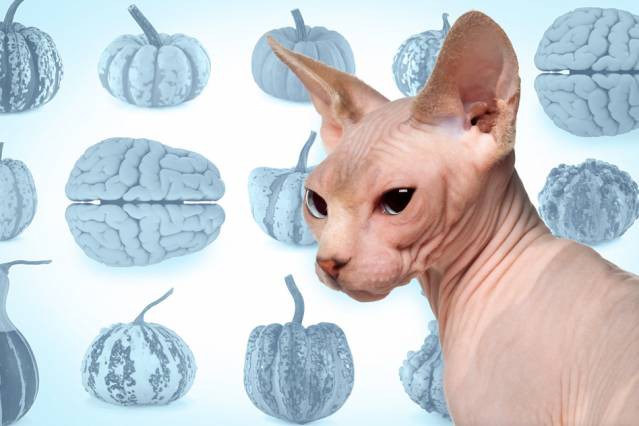
Why do layered materials form one kind of wrinkly pattern or another? MIT associate of mechanical engineering Xuanhe Zhao and postdoc Qiming Wang describe a patterning process that applies to everything, including folds of the brain, wrinkles on a cat, or the ridged skin of pumpkins.
The process of wrinkle formation is familiar to anyone who has ever sat in a bathtub a little too long. But exactly why layered materials sometimes form one kind of wrinkly pattern or another - or even other variations, such as creases, folds, or delaminated buckles - has now been explained at a fundamental level by researchers at MIT. The underlying process is the same in all of these cases: Layers of material with slightly different properties - whether skin tissue or multilayer materials created in the lab - tend to form patterned surfaces when they shrink or stretch in ways that affect the layers differently. But the new analysis, for the first time, creates a unified model that shows exactly how the properties of the individual layers, and how they are bonded to each other, determines the exact form of the resulting texture. MIT associate professor of mechanical engineering Xuanhe Zhao and postdoc Qiming Wang have published their findings in the journal Scientific Reports . The patterning process they describe applies to everything from the folds on the surface of the brain to wrinkles on an aging face, and from the buckling of tree bark to the ridged skin of a pumpkin. By understanding the factors that produce these patterns, the researchers say, it should become easier to design synthetic materials with exactly the kinds of surfaces needed for specific applications - such as better traction, or water-shedding properties.
TO READ THIS ARTICLE, CREATE YOUR ACCOUNT
And extend your reading, free of charge and with no commitment.