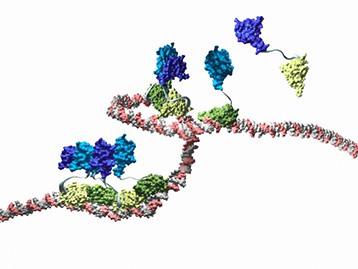
 © Camille Sayou et al., Nature Communications . The LEAFY protein assembling in small chains on DNA (white and red) thanks to its DNA binding domain (pale or dark green) and oligomerization domain .
The LEAFY protein, a transcription factor responsible
1 for flower development, is able to assemble itself in small chains made up of several proteins. This mechanism allows it to bind to and activate regions of the genome that are inaccessible to a single protein. These results were obtained by scientists in the Laboratoire de Physiologie Cellulaire Végétale (CNRS/Inra/CEA/Université Grenoble Alpes) and the Institut de Biologie Structurale (CNRS/CEA/Université Grenoble Alpes)
2, working in collaboration with their international partners. Published on 21 April 2016 in Nature , they open the way to new research opportunities regarding the regulation of gene expression. The LEAFY protein plays an essential role in the beauty of the plant kingdom: it governs the development of flower buds and their different organs (sepals, petals, stamens and pistils). This protein is a transcription factor that is necessary to decipher the genetic code and is endowed with two important domains: one that binds to DNA to activate floral genes, and the second of a hitherto unknown type. The scientists have demonstrated that the latter is a so-called "oligomerization"
3 domain that allows the LEAFY proteins to assemble in small chains.
TO READ THIS ARTICLE, CREATE YOUR ACCOUNT
And extend your reading, free of charge and with no commitment.
Your Benefits
- Access to all content
- Receive newsmails for news and jobs
- Post ads