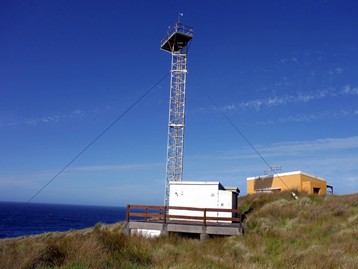
Last month, the atmospheric concentration of carbon dioxide (CO2) as measured at Amsterdam Island, in the southern Indian Ocean, for the first time exceeded the symbolic value of 400 ppm
1, or 0. The CO2 concentrations recorded at the Amsterdam Island research station are the lowest in the world (excluding seasonal cycles), due to the island's remoteness from anthropogenic sources. The 400 ppm threshold was already crossed in the Northern hemisphere during the 2012/2013 winter. In addition, the increase of CO2 in the atmosphere is speeding up, growing by more than 2 ppm annually over the past four years. The data has been collected for the past 35 years at the Amsterdam Island research station by the French national observation service ICOS-France at the Laboratoire des Sciences du Climat et de l'Environnement (LSCE, CNRS / CEA / UVSQ)
2, with the support of the Institut Polaire Français Paul-Emile Victor (IPEV). Due to its remote location, the air in Amsterdam Island is among the cleanest in the world, with the lowest carbon dioxide (CO
2) concentrations (excluding seasonal variations in the Northern hemisphere where, every summer, the amount of CO
2 in the atmosphere falls due to periodic absorption by plants). It has become a reference site for atmospheric chemistry in the Southern hemisphere and is one of the thirty stations in the WMO
3 global network for atmospheric composition monitoring.
TO READ THIS ARTICLE, CREATE YOUR ACCOUNT
And extend your reading, free of charge and with no commitment.
Your Benefits
- Access to all content
- Receive newsmails for news and jobs
- Post ads