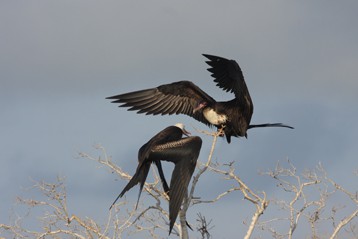
 © A. Prudor / CNRS CEBC A female frigate bird lands near its young, who have acquired the ability to fly, in order to feed them. The flight-learning period can last from 6 to 8 months for young frigate birds, an extraordinary duration for birds.
Frigate birds were already known for their ability to fly continuously for weeks without landing. A telemetric study of their trajectory and flight strategy has just revealed that they can remain airborne for over two months during their transoceanic migrations. These astute strategists take advantage of atmospheric conditions encountered in tropical waters (trade winds and cloud updraft) to fly and glide over thousands of kilometers by minimizing the beating of their wings and thus their energy use. The results of this study, led by Henri Weimerskirch of the Centre d'études biologiques de Chizé (CNRS/Université de La Rochelle) in partnership with colleagues based in La Réunion, the United Kingdom, Canada, and Germany
1, were published on July 1, 2016 . A sea bird that is difficult to observe, which makes it somewhat of an enigma, the frigate bird ( Fregata minor ) is extremely light and equipped with very long and wide wings that give it an extraordinary ability to glide and climb in updrafts without beating its wings. With the longest period of parental care of all birds, and its inability to land on water
2 (even while depending entirely on flying fish that it must capture in flight), the frigate bird is a subject of choice for the Early life
3 research project focusing on the behavior of young marine predators. A team of researchers thus conducted a major program to tag frigate birds on Europa Island in the Mozambique Channel, a breeding ground for the species.
TO READ THIS ARTICLE, CREATE YOUR ACCOUNT
And extend your reading, free of charge and with no commitment.
Your Benefits
- Access to all content
- Receive newsmails for news and jobs
- Post ads