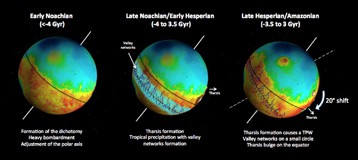
The surface of the planet Mars tilted by 20 to 25 degrees 3 to 3.5 billion years ago. This was caused by a massive volcanic structure, the Tharsis volcanic dome
1, which is the largest in the Solar System. Because of its extraordinary mass, it caused the outer layers of Mars (its crust and mantle) to rotate around its core. The discovery of this huge shift changes our vision of Mars during the first billion years of its history, at a time when life may have emerged. It also provides a solution to three puzzles: we now know why rivers formed where they are observed today; why underground reservoirs of water ice, until now considered anomalous, are located far from the poles of Mars; and why the Tharsis dome is today situated on the equator. These findings are published on 2 March 2016 in the journal Nature by a mainly French team including researchers from Géosciences Paris Sud (CNRS/Université Paris-Sud), Géosciences Environnement Toulouse (CNRS/Université Toulouse III – Paul Sabatier/IRD) and the Laboratoire de Météorologie Dynamique (CNRS/École polytechnique/UPMC/ENS), together with a researcher from the Lunar and Planetary Laboratory (University of Arizona, US). Mars hasn't always looked like it does today.
TO READ THIS ARTICLE, CREATE YOUR ACCOUNT
And extend your reading, free of charge and with no commitment.
Your Benefits
- Access to all content
- Receive newsmails for news and jobs
- Post ads