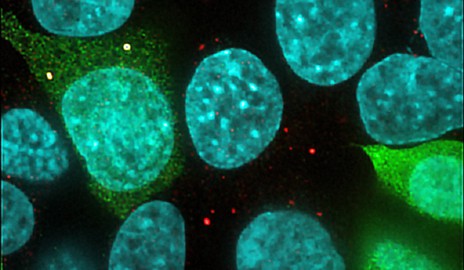
Human kidney cells stained with a P-body marker (red) and NoBody (green). Yellow dots are where P-bodies and NoBody interact. Cell nuclei are shown in blue. (Yale University)
Yale researchers have helped identify a novel, functional 'microprotein' encoded in the human genome, using a technique that has revealed more than 400 new proteins too tiny to be found by other means. One of those microproteins, called NoBody, is a molecular workhorse involved in sweeping out unneeded genetic material inside cells. Its discovery may signal the existence of additional microproteins involved in a host of key biological mechanisms and diseases, the researchers said. 'The broadest significance of this work is that even in a well-studied biological process, a microprotein has been right there under our noses, undetected, all this time,' said Sarah Slavoff, co-senior author of a study published Dec. Chemical Biology. Slavoff is an assistant professor of chemistry and of molecular biophysics and biochemistry at Yale. She is a member of the Chemical Biology Institute at Yale's West Campus.
TO READ THIS ARTICLE, CREATE YOUR ACCOUNT
And extend your reading, free of charge and with no commitment.