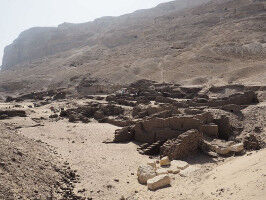
© Photo C. Jarrige, Mission archéologique de l’Indus Photograph of the MR2 archaeological site at Mehrgarh occupied from 4 500 to 3 600 BC, where the amulet was found.
At 6000 years old, this copper amulet is the earliest lost-wax cast object known. Now, researchers have finally discovered how it was made, using a novel UV-visible photoluminescence spectral imaging approach. All the parameters of elaboration process, such as the purity of the copper, and melting and solidification temperatures, are now accurately known. This work has enabled the scientists to solve the mystery of the invention of lost-wax casting, a technique that led to art foundry. Resulting from a collaboration
1 between researchers from the CNRS, the French Ministry of Culture and Communication and the SOLEIL synchrotron, The researchers examined a copper amulet, discovered in the 1980s at a site that was occupied 6,000 years ago and had been a focal point for innovation since Neolithic times: Mehrgarh, in today's Pakistan
2. The shape of the object shows that it was designed using the earliest known precision casting technique, lost-wax casting (still in use today). The process begins with a model formed in a low melting point material such as beeswax.
TO READ THIS ARTICLE, CREATE YOUR ACCOUNT
And extend your reading, free of charge and with no commitment.
Your Benefits
- Access to all content
- Receive newsmails for news and jobs
- Post ads