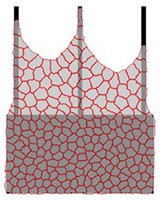
Computer simulations show that skin cell ensembles on a micropatterned substrate simulating a wound can bridge gaps of up to about 200 micrometres.
Scientists from Heidelberg University have developed a novel mathematical model to explore cellular processes: with the corresponding software, they now are able to simulate how large collections of cells behave on given geometrical structures. The software supports the evaluation of microscope-based observations of cell behaviour on micropatterned substrates. One example is a model for wound healing in which skin cells are required to fill a gap. Other areas of application lie in high throughput screening for medicine when a decision needs to be taken automatically on whether a certain active substance changes cell behaviour. Ulrich Schwarz and Dr. Philipp Albert work both at the Institute for Theoretical Physics and at the Bioquant Centre of Heidelberg University. Their findings were recently published in 'PLOS Computational Biology'. One of the most important foundations of the modern Life Sciences is being able to cultivate cells outside the body and to observe them with optical microscopes.
TO READ THIS ARTICLE, CREATE YOUR ACCOUNT
And extend your reading, free of charge and with no commitment.