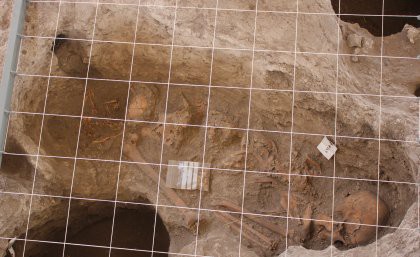
An adult female buried with a small child at her feet. Photo by A. Fairbairn
DNA found in human bones on two Turkish dig sites has shed new light on the ancestry of European farmers, demonstrating a close link between Europe and Asia. University of Queensland researchers collaborated with universities from the UK, Turkey, Sweden and Norway to discover the DNA was from some of the earliest farming villages in central Turkey, proving European farmers were descended from early cultivators who migrated into Europe 8000 to 9000 years ago. UQ School of Social Science researcher Associate Professor Andrew Fairbairn said the research had been designed to test long-held beliefs about the origins of settled farming life in Turkey and Europe. "Excavations at the Boncuklu and Tepecik-Çiftlik dig sites show that early farmers had low genetic diversity, similar to European forager groups, and as farming became better developed, genetic diversity increased," Dr Fairbairn said. He said farming appeared in Europe after 7000 BC and spread across the continent over the next 3000 years or so, with archaeological evidence in central and eastern Europe indicating that colonist farmers were responsible for its spread. "Our research shows a previously unknown second wave of migration from Anatolia into Europe, hypothesised at around 6000 years ago," Dr Fairbairn said. "Archaeological evidence from Turkey and the Balkans suggests that farming spread to Anatolia and then Europe via the 'Fertile Crescent' route - the arc spreading from Israel to southeast Turkey and Iran - in which farming first developed over 10,000 years ago." Dr Fairbairn said the combination of archaeological data with ancient DNA from skeletons had for the first time allowed researchers to evaluate theories using both artefactual and genetic evidence.
TO READ THIS ARTICLE, CREATE YOUR ACCOUNT
And extend your reading, free of charge and with no commitment.