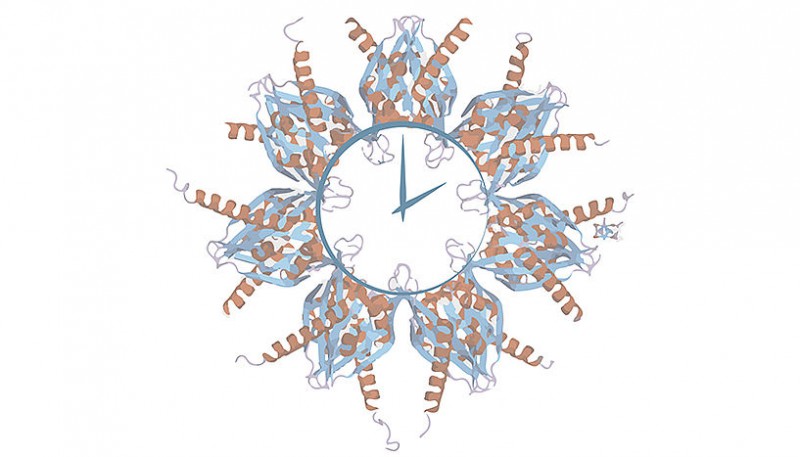
Alternative splicing variants of the enzyme CaMKII make the circadian clock tick faster or slower. Crystal structure of a tetradecameric assembly of the association domain of Ca2+/calmodulin-dependent kinase II (Copyright: Birgit Pöhn).
Humans, as well as many other organisms, possess internal clocks. The exact timing, however, can differ between individuals - for instance, some people are early risers whereas others are "night owls". Neurobiologist Kristin Tessmar-Raible and her team at the Max F. Perutz Laboratories (MFPL) of the University of Vienna and Medical University of Vienna investigated that underlie such timing variations or "chronotypes". The non-biting midge Clunio marinus has two internal clocks, since it times its reproduction according to sun and moon. The team around Tessmar-Raible and Postdoc Tobias Kaiser were now able to identify relevant genes for this adaptation, and published their results in the current issue of "Nature". The non-biting marine midge Clunio marinus lives along Europe's tide-shapen coasts, where precise timing is of existential importance: Reproduction and oviposition must occur when the tide is at its lowest. The tides, and therefore also low tide, are influenced by both the sun and the moon.
TO READ THIS ARTICLE, CREATE YOUR ACCOUNT
And extend your reading, free of charge and with no commitment.