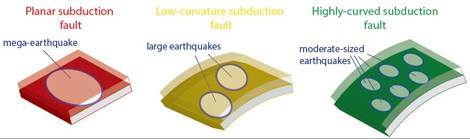
 © Quentin Bletery When a subduction plate is flat (left), the rupture threshold is reached simultaneously over the whole zone, which can start mega-earthquakes. On the contrary, when the subduction plate is highly curved, the threshold is more heterogeneous, leading to more frequent, but more moderate, earthquakes.
Mega-earthquakes (with a magnitude greater than 8.5) mainly occur on subduction faults where one tectonic plate passes under another. But the probability of such earthquakes does not appear to be even across these zones. In a study published on 25 November 2016 in the journal Science , researchers from the University of Oregon and Géoazur laboratory (CNRS/Université Nice Sophia Antipolis/Observatoire de la Côte d'Azur/IRD) show that mega-earthquakes mostly occur on the flattest subduction zones. Thus, the Philippines, Salomon Islands and Vanuatu areas would not be favorable to mega-earthquakes, unlike South America, Indonesia and Japan. The discovery of this new indicator should improve earthquake monitoring and seismic and tsunami risk prevention. At the point where two tectonic plates converge, an area known as the subduction zone can form where one of the plates passes on top of the other. Rocks do not slide over one another easily and the movement of tectonic plates can be blocked along the entire length of such interaction zones for periods exceeding a thousand years.
TO READ THIS ARTICLE, CREATE YOUR ACCOUNT
And extend your reading, free of charge and with no commitment.
Your Benefits
- Access to all content
- Receive newsmails for news and jobs
- Post ads