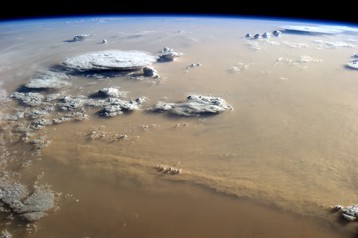
 © NASA / ISS - Digital Camera Image taken from the International Space Station over Libya looking in a south-south-westerly direction, showing a dust storm stretching several hundred kilometers across the Sahara. Isolated cumulonimbus clouds are developing within the dust layer.
So much dust is scattered across the planet by the winds of the Sahara that it alters the climate. However, the emission and transport of this dust, which can reach the poles, fluctuate considerably. Although many hypotheses have been put forward to explain this phenomenon, no unambiguous relationship between this dust and the climate had been established until now. According to research carried out by a French-US team of researchers from LATMOS
1(CNRS/UVSQ/UPMC), CNRM
2(CNRS/Météo-France) and SIO
3, meteorological events such as El Niño and rainfall in the Sahel have an impact on dust emission, by accelerating a Saharan wind downstream of the main mountain massifs of Northwest Africa. The scientists have also developed a new predictive model showing that emissions of Saharan dust will decline over the next hundred years. The Sahara desert emits more dust than any other desert in the world. More than half of the dust deposited in the oceans originates in North Africa.
TO READ THIS ARTICLE, CREATE YOUR ACCOUNT
And extend your reading, free of charge and with no commitment.
Your Benefits
- Access to all content
- Receive newsmails for news and jobs
- Post ads