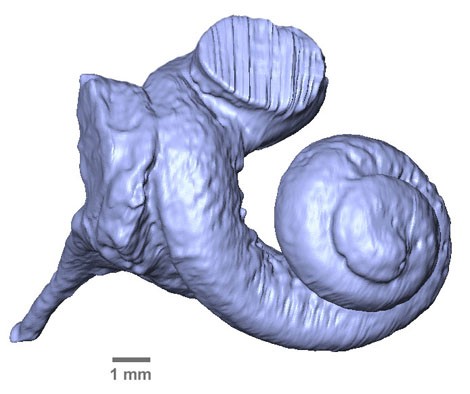
 © M.J. Orliac Digital cochlear cast, ventral view, for Carolinacetus sp. (specimen UM-KPG-M164), one of the protocetid species discovered in Togo.
The hearing organ of the earliest whales, or protocetids, has been digitally reconstructed by paleontologists from the Institut des sciences de l'évolution de Montpellier (CNRS / Université de Montpellier / IRD / EPHE)
1. Despite their essentially aquatic lifestyle, these extinct cetaceans had hind legs that allowed them to move about on land. Virtual casts of the protocetid cochlea, the organ central to hearing, suggest that their auditory ranges were very different from those of their modern cousins. Protocetids - legged whales that became extinct 38 million years ago - gave rise to two major groups of modern whales that differ considerably in their means of communication and hearing abilities. Baleen whales (Mysticeti) can pick up low frequencies and use infrasonic calls to communicate over very long distances. On the other end of the spectrum, toothed whales (Odontoceti) produce ultrasound for echolocation. Until now, two contradictory hypotheses posited a common ancestor with special hearing abilities: one hypothesis suggested sensitivity to infrasound; the other, to ultrasound.
TO READ THIS ARTICLE, CREATE YOUR ACCOUNT
And extend your reading, free of charge and with no commitment.
Your Benefits
- Access to all content
- Receive newsmails for news and jobs
- Post ads