PLoS Genetics, expand the possible mechanisms by which cell death could be targeted to treat human pathologies.
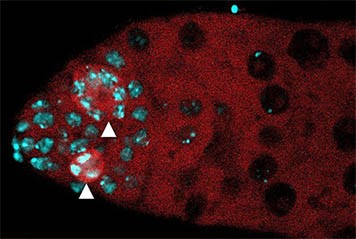
Drosophila testes visualized by confocal microscopy. Necrotic germ cells are visualized in red (white arrowheads), cell nuclei in blue. Victor Girard - Cell death allows elimination of supernumerary cells during development or of abnormal cells throughout life. Physiological cell death is tightly regulated to prevent pathologies such as degenerative diseases or cancers, which often occur due to excessive or absent cell death, respectively. Understanding the mechanisms of cell death pathways is thus crucial for fighting various diseases. The best studied form of cell death, apoptosis, has classically been considered the sole form of cell death during development, while other forms of cell death, referred to as necrosis, were considered accidental. Here, we show that a regulated form of necrosis controls germ cell number during Drosophila spermatogenesis, thus demonstrating that necrosis can play a key role in controlling cell number in physiological conditions.
TO READ THIS ARTICLE, CREATE YOUR ACCOUNT
And extend your reading, free of charge and with no commitment.