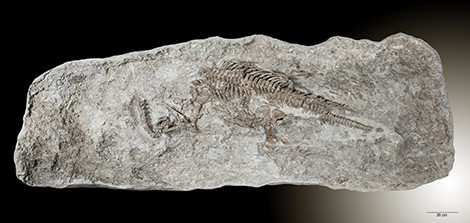
 © Georg Oleschinski Fossil Rhaeticosaurus mertensi plesiosaur, discovered in Westphalia .
While dinosaurs reigned on dry land and in the sky, other reptiles populated the seas and oceans. Of the latter, plesiosaurs, whose means of locomotion may be described as “underwater flight,” formed the most diverse group. But when did they first appear? The discovery of the oldest of these reptiles provides evidence that they had diversified by the start of the Mesozoic Era, during the Triassic Period. What's more, analysis of their bones demonstrates they were warm-blooded and grew rapidly, which enabled their population to spread around the world and live past the Triassic-Jurassic extinction event. These findings by scientists from the University of Bonn (Germany); Osaka University and the University of Tokyo (Japan); and the MECADEV laboratory (CNRS / Muséum National d'Histoire Naturelle) have been published in Science Advances (December 13, 2017). At the end of the Paleozoic Era, 250 million years ago, the largest known mass extinction eliminated 95% of all marine species. In the wake of this event, various groups of reptiles adapted to the marine environment.
TO READ THIS ARTICLE, CREATE YOUR ACCOUNT
And extend your reading, free of charge and with no commitment.
Your Benefits
- Access to all content
- Receive newsmails for news and jobs
- Post ads