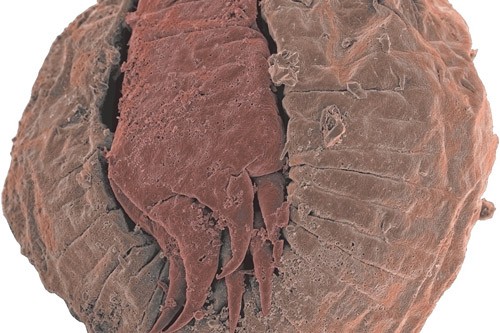
Detail from an embryo of the scalidophoran Markuelia from the Middle Cambrian of Australia.
Philip Donoghue - University of Bristol
The origin of animals was one of the most important events in the history of Earth. Beautifully preserved fossil embryos suggest that our oldest ancestors might have existed a little more than half a billion years ago. Yet, fossils are rare, difficult to interpret, and new, older fossils are constantly discovered. An alternative approach to date the 'tree of life' is the molecular clock, which was introduced in the early 1960s by twice Nobel Laureate Linus Pauling which uses genetic information. Early molecular clock studies assumed that mutation accumulated at a fixed rate across all species and concluded that our oldest ancestor might have existed around 1.5 billions of years ago, a date that is almost three-times as old as the oldest fossil evidence of animal life. These results sparked heated, scientific debates that only eased off in the last decade when a new generation of more realistic 'relaxed' clock methods, that do not assume constancy of the mutation rate, started to close the gap between molecules and fossils indicating that animals are unlikely to be older than around 850 million of years. However, using a recently developed relaxed molecular clock methods called RelTime a team of scientists at Oakland (Michigan) and Temple (Philadelphia) dated the origin of animals at approximately 1.2 billion years ago reviving the debate on the age of the animals.
TO READ THIS ARTICLE, CREATE YOUR ACCOUNT
And extend your reading, free of charge and with no commitment.