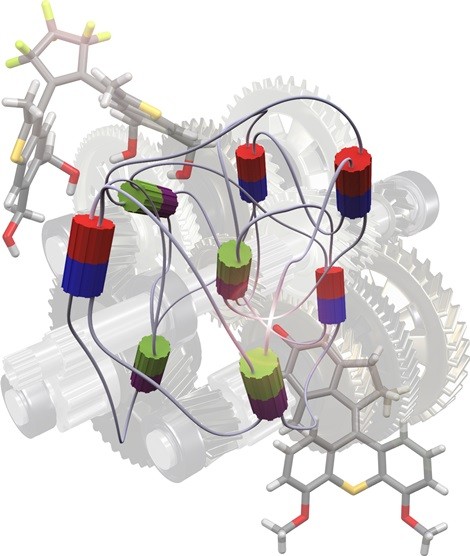
 © Gad Fuks / Nicolas Giuseppone / Mathieu Lejeune/ Woverwolf/Shutterstock.com Artistic rendition of a nanomachine combining motor (red and blue) and clutch (green and purple) subunits connected by transmission subunits (polymer chains represented as strings).
These two types of subunits turn in opposite directions when exposed to two distinct light sources. When the motors turn (activated by UV light), they braid the pairs of polymer chains, and the material contracts. When the clutch subunits turn (under the effect of white light), they unbraid the polymer chains, and the material extends. By varying light intensity, it is possible to modulate the relative frequency of the braiding and unbraiding, and to thereby manage the overall transmission of the movement, similar to a vehicle’s gearbox.
The motor subunit is represented in detail on the lower right, and the modulator subunit on the upper left.
© Gad Fuks / Nicolas Giuseppone / Mathieu Lejeune/ Woverwolf/Shutterstock.com Artistic rendition of a nanomachine combining motor (red and blue) and clutch (green and purple) subunits connected by transmission subunits (polymer chains represented as strings).
These two types of subunits turn in opposite directions when exposed to two distinct light sources. When the motors turn (activated by UV light), they braid the pairs of polymer chains, and the material contracts. When the clutch subunits turn (under the effect of white light), they unbraid the polymer chains, and the material extends. By varying light intensity, it is possible to modulate the relative frequency of the braiding and unbraiding, and to thereby manage the overall transmission of the movement, similar to a vehicle’s gearbox.
The motor subunit is represented in detail on the lower right, and the modulator subunit on the upper left.
Rewarded with a Nobel Prize in Chemistry in 2016, nanomachines provide mechanical work on the smallest of scales. Yet at such small dimensions, molecular motors can complete this work in only one direction. Researchers from the CNRS's Institut Charles Sadron, led by Nicolas Giuseppone, a professor at the Université de Strasbourg, working in collaboration with the Laboratoire de mathématiques d'Orsay (CNRS/Université Paris-Sud), have succeeded in developing more complex molecular machines that can work in one direction and its opposite. The system can even be controlled precisely, in the same way as a gearbox. The study was published on March 20, 2017. Molecular motors can produce cyclical mechanical movement using an external energy source, such as a chemical or light source, combined with Brownian motion (disorganized and random movement of surrounding molecules). However, nanomotors are exposed to molecular collisions on all sides, which complicates the production of directed and hence useful mechanical work.
TO READ THIS ARTICLE, CREATE YOUR ACCOUNT
And extend your reading, free of charge and with no commitment.
Your Benefits
- Access to all content
- Receive newsmails for news and jobs
- Post ads