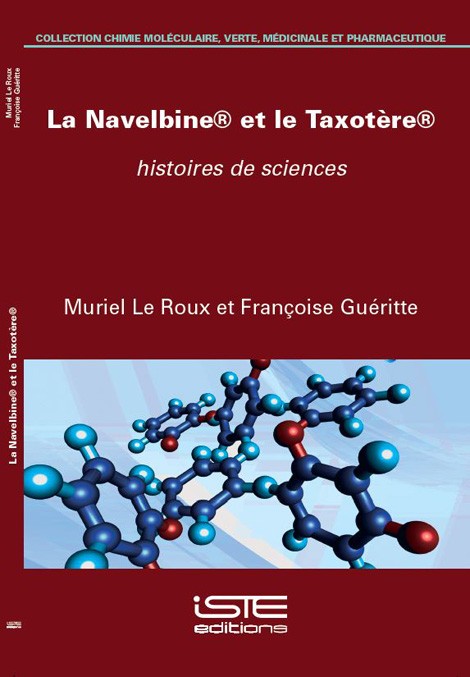
Navelbine and Taxotere : Histories of Sciences
ISTE Editions
Collection: Molecular, Green, Medicinal, and Pharmaceutical Chemistry
Muriel Le Roux and Françoise Guéritte
222 pages. Hardcover: €44;
eBook: €9.90 (personal purchases only).
Weaving history with chemistry, Navelbine and Taxotere : Histories of Sciences (ISTE Editions, June 2017) tells the story of two anticancer drugs—both of natural origin—discovered by teams of researchers at the CNRS Institut de Chimie des Substances Naturelles (ICSN). Authored by historian Muriel Le Roux and chemist Françoise Guéritte, the book considers how public research and industry research work together in the French system. The anticancer arsenal includes many treatments. One of the most effective is chemotherapy, for which Navelbine and Taxotere have both played major roles. Navelbine and Taxotere : Histories of Sciences blends history and chemistry as it recounts the discovery of the two drugs—while considering the associated political, scientific, and economic environment. In the mid-1980s, a team of ICSN researchers led by Pierre Potier synthesized Taxotere —hailed as more effective than Taxol —using a natural precursor extracted from the English yew ( Taxus baccata ).1By bringing their find out of the lab and into the factory, Potier's team, together with colleagues at the former French chemical and pharmaceutical company Rhône-Poulenc and Université de Grenoble, removed the technological and industrial barriers that had stymied Taxol production. A few years earlier, another ICSN team led by Potier had solved the puzzle behind the synthesis of vinblastine and vincristine, two natural compounds isolated from the rosy periwinkle ( Catharantus roseus ).
TO READ THIS ARTICLE, CREATE YOUR ACCOUNT
And extend your reading, free of charge and with no commitment.