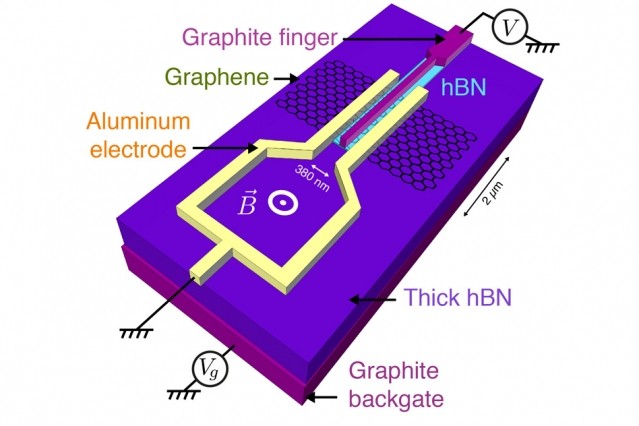
MIT physicists have found that a flake of graphene, when brought in close proximity with two superconducting materials, can inherit some of those materials’ superconducting qualities. As graphene is sandwiched between superconductors, its electronic state changes dramatically, even at its center. Pictured is the experimental concept and device schematic.
In normal conductive materials such as silver and copper, electric current flows with varying degrees of resistance, in the form of individual electrons that ping-pong off defects, dissipating energy as they go. Superconductors, by contrast, are so named for their remarkable ability to conduct electricity without resistance, by means of electrons that pair up and move through a material as one, generating no friction. Now MIT physicists have found that a flake of graphene, when brought in close proximity with two superconducting materials, can inherit some of those materials' superconducting qualities. As graphene is sandwiched between superconductors, its electronic state changes dramatically, even at its center. The researchers found that graphene's electrons, formerly behaving as individual, scattering particles, instead pair up in 'Andreev states' - a fundamental electronic configuration that allows a conventional, nonsuperconducting material to carry a 'supercurrent,' an electric current that flows without dissipating energy. Their findings, published this week , are the first investigation of Andreev states due to superconductivity's 'proximity effect' in a two-dimensional material such as graphene. Down the road, the researchers' graphene platform may be used to explore exotic particles, such as Majorana fermions, which are thought to arise from Andreev states and may be key particles for building powerful, error-proof quantum computers.
TO READ THIS ARTICLE, CREATE YOUR ACCOUNT
And extend your reading, free of charge and with no commitment.