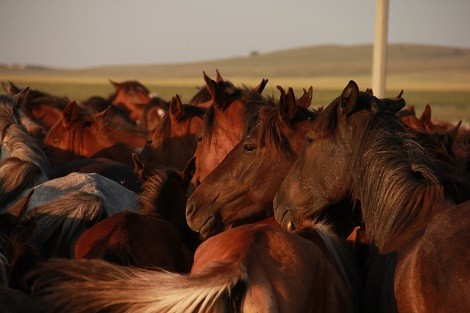
 © Ludovic Orlando, Natural History Museum of Denmark, CNRS Modern Kazakh horse domesticates
By studying the genome of Scythian horses, an international team of researchers is outlining the relations that these nomads from Iron Age Central Asia had with their horses—and lifting the veil on some of the mysteries of animal domestication. Published in the journal Science on April 28, 2017, this research was led by Ludovic Orlando, CNRS senior researcher at the Laboratory of Molecular Anthropology and Image Synthesis (CNRS/Université Toulouse III – Paul Sabatier/Université Paris Descartes) and professor at the Natural History Museum of Denmark.
1 Nomadic Scythian herders roamed vast areas spanning the Central Asian steppes during the Iron Age (from approximately the ninth to the first century BCE (Before Common Era)). They were known for their exceptional equestrian skills, and their leaders were buried with sacrificed stallions at grand funerary ceremonies. The genomes of a few of these equids were fully sequenced as part of this study, so as to form a better understanding of the relations that the Scythian people developed with their horses. The researchers sequenced the genomes of thirteen 2,300–2,700-year-old stallions from the Scythian royal burial tombs of Arzhan (Russian Republic of Tuva, in the outer reaches of Mongolia) and Berel' (Kazakh Altai Mountains). They also sequenced the genome of a mare from an older culture, found in Chelyabinsk (Russia), and which is 4,100 years old.
TO READ THIS ARTICLE, CREATE YOUR ACCOUNT
And extend your reading, free of charge and with no commitment.
Your Benefits
- Access to all content
- Receive newsmails for news and jobs
- Post ads