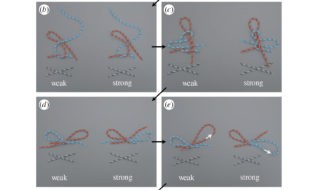
Click to enlarge: An overhead view of how to tie the weak knot (left) and the strong knot (right). The two knots only differ in the relative tying of the second trefoil to the first trefoil (panels b and c). After the loops are pulled out (indicated by the white arrows), the weak and strong knots become the prototypical false and square knots.
!- Start of DoubleClick Floodlight Tag: Please do not remove Activity name of this tag: UCB001CP Retargeting URL of the webpage where the tag is expected to be placed: http://unknown This tag must be placed between the A new study by mechanical engineers at UC Berkeley finally shows why your shoelaces may keep coming untied. It's a question that everyone asks, often after stopping to retie their shoes, yet one that nobody had investigated until now. The answer, the study suggests, is that a double whammy of stomping and whipping forces acts like an invisible hand, loosening the knot and then tugging on the free ends of your laces until the whole thing unravels. The study is more than an example of science answering a seemingly obvious question. A better understanding of knot mechanics is needed for sharper insight into how knotted structures fail under a variety of forces. Using a slow-motion camera and a series of experiments, the study shows that shoelace knot failure happens in a matter of seconds, triggered by a complex interaction of forces. 'When you talk about knotted structures, if you can start to understand the shoelace, then you can apply it to other things, like DNA or microstructures, that fail under dynamic forces,' said Christopher Daily-Diamond, study co-author and a graduate student at Berkeley.
TO READ THIS ARTICLE, CREATE YOUR ACCOUNT
And extend your reading, free of charge and with no commitment.