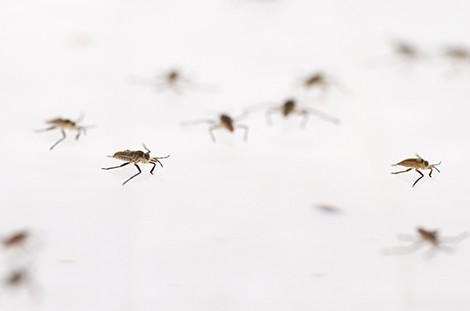
 © Abderrahman Khila, IGFL (CNRS / ENS de Lyon / Claude Bernard Lyon 1 University). Rhagovelia walking on water.
How do new species arise and diversify in nature? Natural selection offers an explanation, but the genetic and environmental conditions behind this mechanism are still poorly understood. A team led by Abderrahman Khila—CNRS Senior Researcher at the Institute of Functional Genomics of Lyon (CNRS / ENS de Lyon / Claude Bernard Lyon 1 University), or IGFL—has just figured out how water striders (family Veliidae) of the genus Rhagovelia developed fan-like structures at the tips of their legs. These structures allow them to move upstream against the current, a feat beyond the abilities of other water striders that don't have fans. The researchers identified two genes, hitherto unknown, that are responsible for the formation of Rhagovelia leg fans. Rhagovelia belong to a group of insects (Gerromorpha) that stand out for their ability to walk on water. Water-repellent hairs covering their legs make this possible. Unlike other Gerromorpha, Rhagovelia are specialized for locomotion on streams with strong currents using fan-like extensions on their second pair of legs that act as swimming fins.
TO READ THIS ARTICLE, CREATE YOUR ACCOUNT
And extend your reading, free of charge and with no commitment.
Your Benefits
- Access to all content
- Receive newsmails for news and jobs
- Post ads