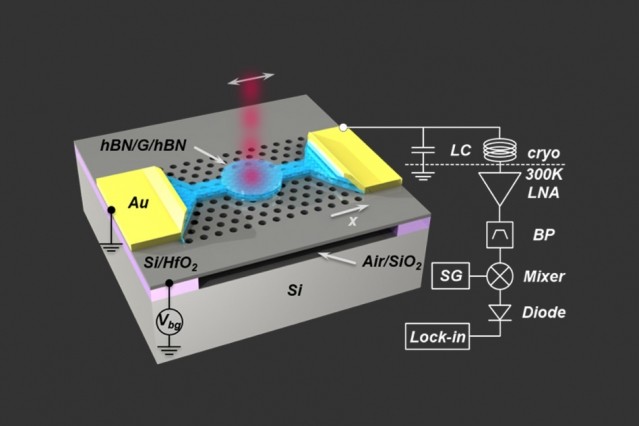
Schematic illustration of the experimental setup
Bolometers, devices that monitor electromagnetic radiation through heating of an absorbing material, are used by astronomers and homeowners alike. But most such devices have limited bandwidth and must be operated at ultralow temperatures. Now, researchers say they've found a ultrafast yet highly sensitive alternative that can work at room temperature - and may be much less expensive. The findings, published today , could help pave the way toward new kinds of astronomical observatories for long-wavelength emissions, new heat sensors for buildings, and even new kinds of quantum sensing and information processing devices, the multidisciplinary research team says. The group includes recent MIT postdoc Dmitri Efetov, Professor Dirk Englund of MIT's Department of Electrical Engineering and Computer Science, Kin Chung Fong of Raytheon BBN Technologies, and colleagues from MIT and Columbia University. "We believe that our work opens the door to new types of efficient bolometers based on low-dimensional materials," says Englund, the paper's senior author. He says the new system, based on the heating of electrons in a small piece of a two-dimensional form of carbon called graphene, for the first time combines both high sensitivity and high bandwidth - orders of magnitude greater than that of conventional bolometers - in a single device.
TO READ THIS ARTICLE, CREATE YOUR ACCOUNT
And extend your reading, free of charge and with no commitment.