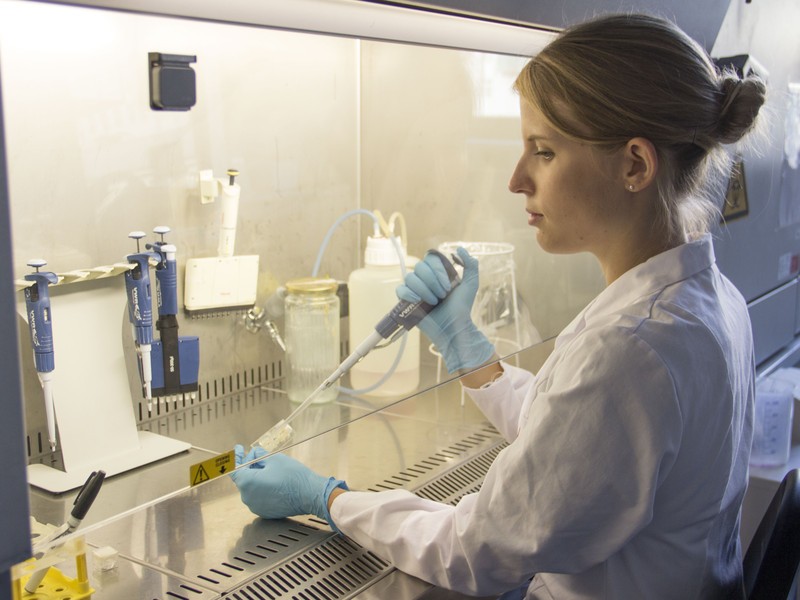
Denise Mandt in the lab
In order to better understand important biological membranes, it is necessary to explore new methods. Researchers at TU Wien (Vienna) have succeeded in creating an artificial placental barrier on a chip, using a high-resolution 3D printing process. The placenta has an essential and highly complex task: it must ensure the exchange of important substances between the mother and her unborn child, whilst simultaneously blocking other substances from passing through. Until now, it has not been fully understood what the permeability of the placenta depends on - after all, it is incredibly difficult to investigate its function in humans directly. For this reason, TU Wien (Vienna) has now produced an artificial placenta model that very closely resembles the natural organ. Using a specially developed femtosecond laser-based 3D printing process, it is possible to produce customized hydrogel membranes directly within microfluidic chips, which are then populated with placenta cells. This means it is now possible to provide clarity in some vital research issues, such as the exchange of glucose between mother and child.
TO READ THIS ARTICLE, CREATE YOUR ACCOUNT
And extend your reading, free of charge and with no commitment.