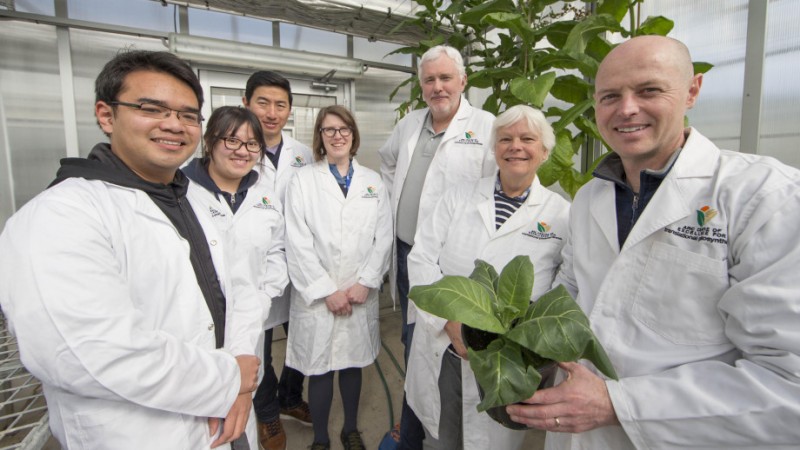
From left to right is Nghiem D. Hguyen, Eng Kee Au, Wei Yih Hee, Eiri Heyno, Dean Price, Susanne van Caemmerer and Research Fellow Dr Ben Long. Credit: ANU
Scientists at ANU have engineered tiny carbon-capturing engines from blue-green algae into plants, in a breakthrough that promises to help boost the yields of important food crops such as wheat, cowpeas and cassava. Lead researcher Dr Ben Long from ANU said the discovery was a major leap forward in improving the way crops convert carbon dioxide, water and sunlight into energy - a process called photosynthesis, which is one of the main limitations to crop yield. These compartments, called carboxysomes, are responsible for making cyanobacteria so efficient at transforming carbon dioxide into energy-rich sugars. "Until now, inserting a carboxysome into a plant had been in the realm of science fiction and it has taken us more than five years to get to this point," Dr Long said. "We are trying to insert a turbo-charged carbon-capturing engine into plants, by mimicking a solution that cyanobacteria - the ancestors of modern plant chloroplasts, the green compartments where plants make their own food - found millions of years ago." Rubisco, the enzyme responsible for fixing carbon dioxide from the atmosphere, is slow and finds it difficult to differentiate between carbon dioxide and oxygen, leading to wasteful energy loss. "Unlike crop plants, cyanobacteria use what's called a 'CO2 concentrating mechanism' to deliver large amounts of the gas into their carboxysomes, where their Rubisco is encapsulated," Dr Long said. "This mechanism increases the speed in which CO2 can be turned into sugar and minimises reactions with oxygen." The Rubisco enzyme inside cyanobacteria can capture carbon dioxide and generate sugars about three times faster than the Rubisco found in plants.
TO READ THIS ARTICLE, CREATE YOUR ACCOUNT
And extend your reading, free of charge and with no commitment.