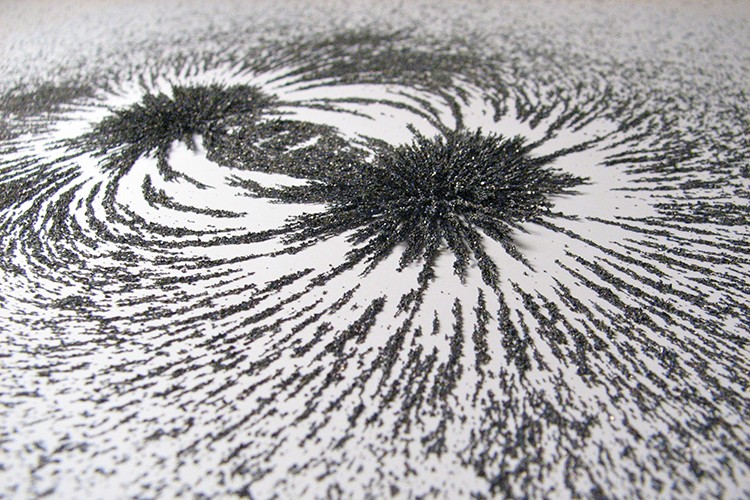
A new device developed by UC Berkeley engineers provides low-cost, high-efficiency magnetic field detection. (Credit: Windell Oskay, via Flickr)
Click to share on Google+ (Opens in new window) Click to share on Reddit (Opens in new window) Click to print (Opens in new window) - UC Berkeley engineers have created a device that dramatically reduces the energy needed to power magnetic field detectors, which could revolutionize how we measure the magnetic fields that flow through our electronics, our planet and even our bodies. "The best magnetic sensors out there today are bulky, only operate at extreme temperatures and can cost tens of thousands of dollars," said Dominic Labanowski, who helped create the device, which is made from nitrogen-infused diamonds, as a postdoctoral researcher in the Department of Electrical Engineering and Computer Science. "Our sensors could replace those more-difficult-to-use sensors in a lot of applications from navigation to medical imaging to natural resource exploration." Each time a diamond-based sensor measures a magnetic field, it must first be blasted with 1 to 10 watts of microwave radiation to prime them to be sensitive to magnetic fields, which is enough power to melt electronic components. The researchers found a new way to excite tiny diamonds with microwaves using 1,000 times less power, making it feasible to create magnetic-sensing devices that can fit into electronics like cell phones. This work was led by the lab of EECS professor Sayeef Salahuddin at UC Berkeley in collaboration with researchers from the Ohio State University. The team reports their device online Sep. 7 in the journal Science Advances .
TO READ THIS ARTICLE, CREATE YOUR ACCOUNT
And extend your reading, free of charge and with no commitment.