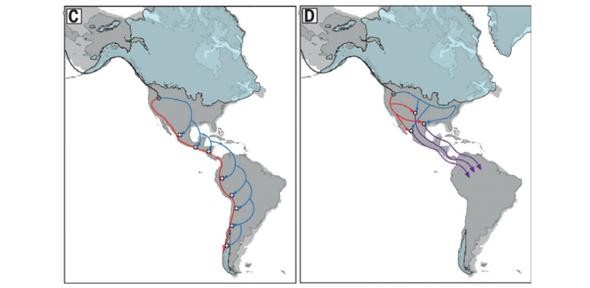
Two of the four possible combinations of ancient admixture highlighted by the researchers.
Credit: Scheib/Kivisild/Mahli
New research using ancient DNA finds that a population split after people first arrived in North America was maintained for millennia before mixing again before or during the expansion of humans into the southern continent. The lab-based science should only be a part of the research. We need to work with Indigenous communities in a more holistic way - Dr Christiana Scheib Recent research has suggested that the first people to enter the Americas split into two ancestral branches, the northern and southern, and that the "southern branch" gave rise to all populations in Central and South America. Now, a study shows for the first time that, deep in their genetic history, the majority - if not all - of the Indigenous peoples of the southern continent retain at least some DNA from the "northern branch": the direct ancestors of many Native communities living today in the Canadian east. The latest findings while these two populations may have remained separate for millennia - long enough for distinct genetic ancestries to emerge - they came back together before or during the expansion of people into South America. The new analyses of 91 ancient genomes from sites in California and Canada also provide further evidence that the first peoples separated into two populations between 18,000 and 15,000 years ago. This would have been during or after migrating across the now-submerged land bridge from Siberia along the coast.
TO READ THIS ARTICLE, CREATE YOUR ACCOUNT
And extend your reading, free of charge and with no commitment.