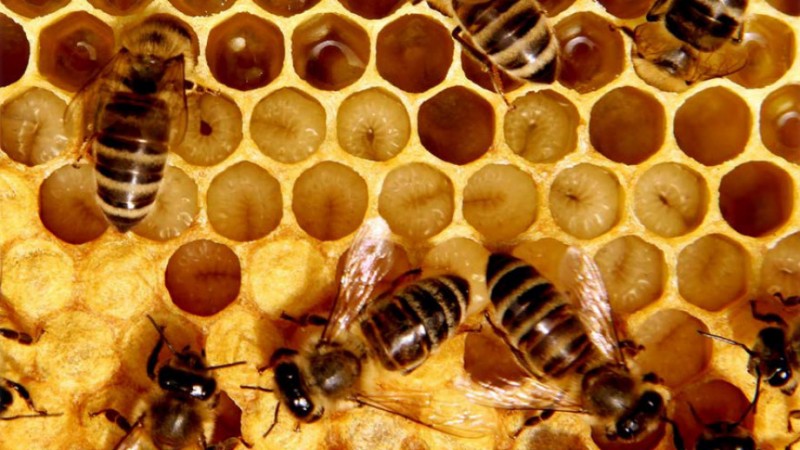
Honey bees. Image credit, ANU
They say leaders are born not made, but it seems the opposite is true for queen bees, according to a new study by researchers from The Australian National University (ANU) and Queen Mary University of London. Larvae turn into queen bees when they are fed a nutritious diet called 'royal jelly'. Royal jelly has the capacity to influence the genetic instructions encoded in the honey bee genome, a process called 'epigenetics' or 'above genetics'. So how does this quirk of nature actually work? "We hypothesised that royal jelly acts via a special class of proteins called histones that are directly associated with DNA and control both structural and functional aspects of our genetic hardware," Ryszard Maleszka from the ANU Research School of Biology said. "These proteins are modified by various chemical tags, which provides them with the needed flexibility to coordinate the expression of all genes and respond to changing extremal conditions." Bees are eusocial insects, meaning there's usually one individual who reproduces (the queen) and the rest of the females in the colony perform a large repertoire of tasks. They all start out with the same genetic blueprint, but differential feeding controls their developmental fate, setting a larva on the path to becoming a queen, or a sterile worker. The study found big differences in genes involved in certain behaviours and brain development.
TO READ THIS ARTICLE, CREATE YOUR ACCOUNT
And extend your reading, free of charge and with no commitment.