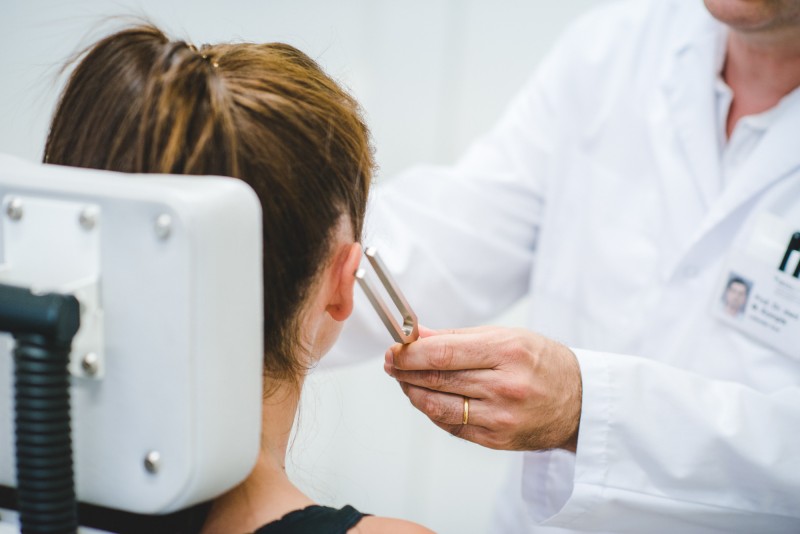
 Audiological examination, University Department of Ear, Nose, Throat (ENT), Head and Neck Surgery, Bern University Hospital.
Researchers from the University of Bern and Bern University Hospital have managed for the first time to differentiate human inner ear cells in a laboratory from somatic progenitors and to investigate their origin. This will make it possible to develop new treatment methods for hearing impairment in the future. About 5% of the world population suffers from hearing impairment. Disabling hearing loss has far-reaching implications for those concerned and society as a whole. Hearing loss in adults alone ranks among the five largest disease burdens in Europe and generates enormous socioeconomic costs. Hearing ability can be improved with hearing aids or cochlear implants, but to this day there is no causal treatment for hearing impairments. A group of researchers from the Department for BioMedical Research (DBMR) at the University of Bern and the University Department of Ear, Nose, Throat (ENT), Head and Neck Surgery at Bern University Hospital has now made a big step towards establishing new methods that will serve for the developing new therapy of hearing impairment.
TO READ THIS ARTICLE, CREATE YOUR ACCOUNT
And extend your reading, free of charge and with no commitment.
Your Benefits
- Access to all content
- Receive newsmails for news and jobs
- Post ads