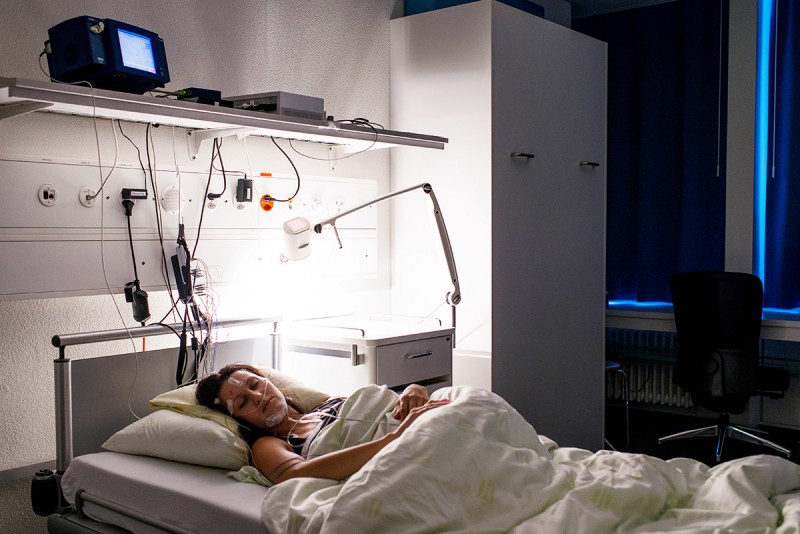
Sleeping Lab at the University Sleep-Wake-Epilepsy-Centre. Photo: Tanja Läser / Insel Gruppe AG.
Patients with a rare disease, called narcolepsy, suffer of excessive daytime sleepiness and cataplexy. A study published in the renowned scientific journal Nature reports the cause of the disease, which has previously been a mystery. The study is the result of a close collaboration between researchers from the University Sleep-Wake-Epilepsy-Centre Bern at the University Hospital (Inselspital), the Institute for Research in Biomedicine in Bellinzona and ETH Zurich. The study is the result of a close collaboration between basic and clinical scientists and was jointly coordinated by Prof. Federica Sallusto at the Institute for Research in Biomedicine in Bellinzona (IRB, affiliated to USI Università della Svizzera italiana) and at ETH Zurich, and Prof. Claudio Bassetti at the University Sleep-Wake-Epilepsy-Center Bern of the Department of Neurology at the University Hospital (Inselspital) in Bern. The study also involved the Neurocenter of Southern Switzerland of the Ente Ospedaliero Cantonale, the Center for Sleep Research and Sleep Medicine of the Clinic Barmelweid, the Department of Physiology at the University of Lausanne, the Institute of Experimental Immunology at the University of Zurich, and the Institute of Immunology at the University Witten/Herdecke in Germany. According to Prof. Federica Sallusto: 'Using new sensitive methods we have been able to identify T lymphocytes reactive against hypocretin as the culprit of this disease. These autoreactive T lymphocytes can cause inflammation leading to neuronal damage or even kill hypocretin-producing neurons.
TO READ THIS ARTICLE, CREATE YOUR ACCOUNT
And extend your reading, free of charge and with no commitment.