© E. Lupoli, Jean Bérard Centre (CNRS/École française de Rome) Painted burial chamber (from 2nd century B.C.) excavated in 2018
Burial chamber interior and scenes depicting figures, preserved on the entrance wall and half of the side walls. The entrance wall right of the door depicts a naked servant, standing and holding a silver-plated jug and vase for wine. To his left, a krater (vase) on a stand is visible. To the left of the door are a silver-plated situla, a type of bucket-shaped vessel, a wooden table and a wine amphora on a stand. On the side walls are what appear to be landscape scenes.
© E. Lupoli, Jean Bérard Centre (CNRS/École française de Rome) Painted burial chamber (from 2nd century B.C.) excavated in 2018
Burial chamber interior and scenes depicting figures, preserved on the entrance wall and half of the side walls. The entrance wall right of the door depicts a naked servant, standing and holding a silver-plated jug and vase for wine. To his left, a krater (vase) on a stand is visible. To the left of the door are a silver-plated situla, a type of bucket-shaped vessel, a wooden table and a wine amphora on a stand. On the side walls are what appear to be landscape scenes.
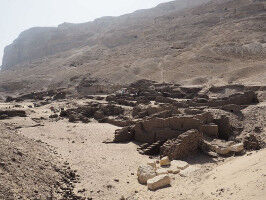
At the foot of the hill on which sits the ancient city of Cumae, in the region of Naples, Priscilla Munzi, CNRS researcher at the Jean Bérard Centre (CNRS-EFR), and Jean-Pierre Brun, professor at the Collège de France, are exploring a Roman-era necropolis. They now reveal the latest discovery to surface in the archaeological dig they have led since 2001: a painted tomb from the 2nd century B.C. In excellent condition, the tomb depicts a banquet scene, fixed by pigments. Twice the size of Pompeii, the ancient city of Cumae is located 25 km west of Naples on the Tyrrhenian Sea facing the island of Ischia, at the Campi Flegrei Archaeological Park. Ancient historians considered Cumae the oldest Ancient Greek settlement in the western world. Founded in the latter half of the 8th century B.C. by Greeks from Euboea, the settlement grew quickly and prospered over time. In recent years, French researchers have focused on an area where a Greek sanctuary, roads and a necropolis were found. Among the hundreds of ancient sepulchres unearthed since 2001, they have discovered a series of vaulted burial chambers made of tuff, a volcanic stone found in the area.
TO READ THIS ARTICLE, CREATE YOUR ACCOUNT
And extend your reading, free of charge and with no commitment.
Your Benefits
- Access to all content
- Receive newsmails for news and jobs
- Post ads