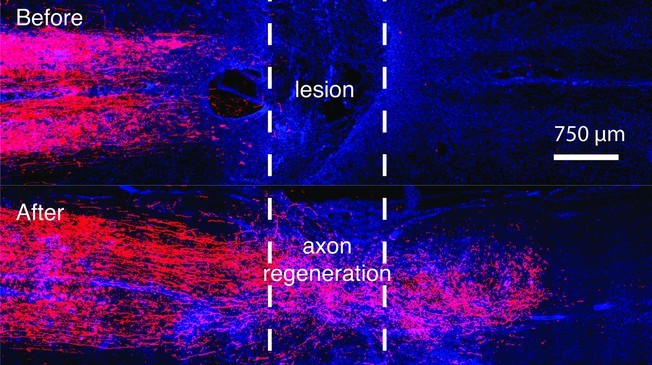
Scientists have designed a three-stepped recipe for regenerating electro-physiologically active nerve fibers across complete spinal cord lesions in rodents. Rehabilitation is still required to make these new nerve fibers functional for walking. The results appear in today's issue of Nature. The adult mammalian body has an incredible ability to heal itself in response to injury. Yet, injuries to the spinal cord lead to devastating conditions, since severed nerve fibers fail to regenerate in the central nervous system. Consequently, the brain's electrical commands about body movement no longer reach the muscles, leading to complete and permanent paralysis. But what if it were possible to bridge the gap in the severed spinal cord? What if it were possible to regenerate severed nerve fibers across spinal cord injury? In a collaboration led by EPFL (Ecole polytechnique fédérale de Lausanne) in Switzerland and UCLA (University of California at Los Angeles) in the USA, scientists have now understood the underlying biological mechanisms required for severed nerve fibers to regenerate across complete spinal cord injury, bridging that gap in mice and rats for the first time.
TO READ THIS ARTICLE, CREATE YOUR ACCOUNT
And extend your reading, free of charge and with no commitment.
Your Benefits
- Access to all content
- Receive newsmails for news and jobs
- Post ads