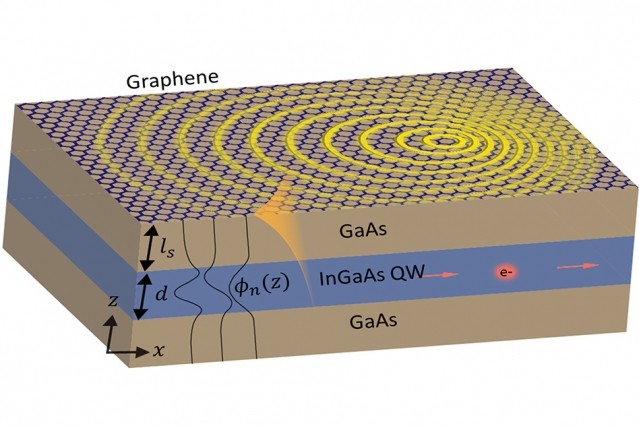
Researchers at MIT and Israel’s Technion used a thin-film material composed of layers of gallium-arsenide and indium-gallium-arsenide, overlaid with a layer of graphene, as shown in this diagram, to produce strong interactions between light and particles that could someday enable highly tunable lasers or LEDs.
A new way of enhancing the interactions between light and matter, developed by researchers at MIT and Israel's Technion, could someday lead to more efficient solar cells that collect a wider range of light wavelengths, and new kinds of lasers and light-emitting diodes (LEDs) that could have fully tunable color emissions. The fundamental principle behind the new approach is a way to get the momentum of light particles, called photons, to more closely match that of electrons, which is normally many orders of magnitude greater. Because of the huge disparity in momentum, these particles usually interact very weakly; bringing their momenta closer together enables much greater control over their interactions, which could enable new kinds of basic research on these processes as well as a host of new applications, the researchers say. The new findings, based on a theoretical study, are being published today in a paper by Yaniv Kurman of Technion (the Israel Institute of Technology, in Haifa); MIT graduate student Nicholas Rivera; MIT postdoc Thomas Christensen; John Joannopoulos, the Francis Wright Davis Professor of Physics at MIT; Marin Solja'i', professor of physics at MIT; Ido Kaminer, a professor of physics at Technion and former MIT postdoc; and Shai Tsesses and Meir Orenstein at Technion. While silicon is a hugely important substance as the basis for most present-day electronics, it is not well-suited for applications that involve light, such as LEDs and solar cells - even though it is currently the principal material used for solar cells despite its low efficiency, Kaminer says.
TO READ THIS ARTICLE, CREATE YOUR ACCOUNT
And extend your reading, free of charge and with no commitment.