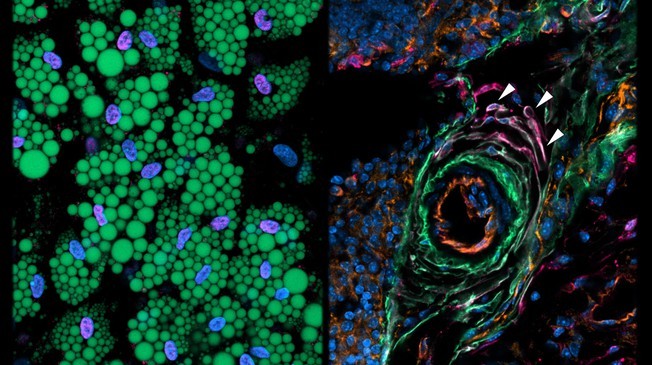
Credit: B. Deplancke/EPFL
A study led by researchers in Switzerland has revealed a new cell type that resides in the body's fat depots where it can actively suppress fat cell formation. This discovery was made using single-cell transcriptomics and opens entirely new avenues to combat obesity and related diseases such as diabetes. Image: Two different aspects of fat: left, mature human fat cells grown in a Petri dish (green: lipid droplets); right, a section of mouse fat tissue with in the middle, a blood vessel (red circle) surrounded by Aregs (arrows), newly discovered cells capable of suppressing adipogenesis (credit: B. Deplancke/EPFL). Fat cells, or adipocytes, are at the center of nutritional and metabolic balance. Adipogenesis - the formation of mature fat cells from their precursor cells - has been linked to obesity and related health problems such as cardiovascular disease and type-2 diabetes. However, it has proven very challenging to determine the identity and molecular properties of fat cell precursors. This is because, next to adipocytes and blood cells, fat tissue contains a large number of stromal cells that are difficult to distinguish using traditional approaches such as genetic labeling.
TO READ THIS ARTICLE, CREATE YOUR ACCOUNT
And extend your reading, free of charge and with no commitment.