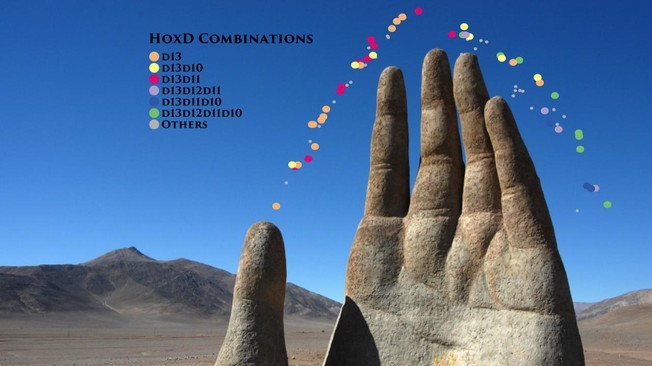
Growing hand with HoxD combinatorial code (credit: P. Fabre and Q. Lo Giudice, University of Geneva)
Scientists from EPFL and the University of Geneva have discovered a "code" of architect genes that are expressed in specific combinations during the development of hands and fingers. The study decrypts developmental gene expression at the level of the single cell in developing limbs and expands our understanding of the genetics behind growing limbs. Image: Growing hand with HoxD combinatorial code. The image below is an overlay of the large-scale hand sculpture with Hox genes combinatorial code distribution along a diffusion map, illustrating genetic diversity in the growing limb. Each dot being one cell, the colors represent the single-cell combinatorial Hoxd code that match with different degree of differentiation, a recent concept also described as pseudo-temporal ordering of single-cells. The graphic highlights the switch between cellular temporal states involved in a regulatory network. The cells with only one gene are in a more premature state while the one expressing a higher set of these genes being at the end of their maturation. Credit: Sculpture and "del desierto" from Chilean sculptor Mario Irrarazabal in Atacama Desert. Graphical representation of pseudotime by P. Fabre and Q. Lo Giudice, University of Geneva. When a fetus develops, everything must be timed to perfection: cell division and differentiation, gene expression, cell-to-cell signaling, and morphogenesis must be carefully coordinated to occur in the correct sequence and for the proper amount of time. Failures in timing can result in congenital deformities, disabilities, and even death. The big question that developmental biologists have been asking for a long time is this: what sets the pace and the order of developmental events?
TO READ THIS ARTICLE, CREATE YOUR ACCOUNT
And extend your reading, free of charge and with no commitment.