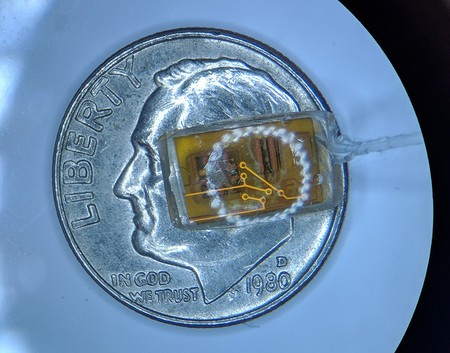
A new pressure-sensing implant for the eye could help glaucoma patients monitor their own condition.
Electrical and medical engineering researchers create device that makes it easier to measure pressure inside the eyes of people at risk for glaucoma. Researchers at Caltech have developed an implantable pressure sensor that can reside in the human eye for years at a time while wirelessly sending data about the eye's health to the patient or medical professionals. The implant could make it easier to prevent one of the leading causes of blindness. "By bringing together novel packaging and microelectronic technologies, and in close collaborations with ophthalmologists, we were able to design a miniaturized, fully wireless, and highly-sensitive sensor," says Azita Emami , Caltech's Andrew and Peggy Cherng Professor of Electrical Engineering and Medical Engineering and a Heritage Medical Research Institute Investigator, and paper co-author. The sensor is designed for monitoring the eyes of patients with glaucoma, a disease that causes gradual loss of vision, usually as a result of excessively high pressure inside the eye. Glaucoma is the second-most-common cause of blindness after cataracts, affecting 65 million people worldwide. Patients at risk for glaucoma are required to make regular visits to an ophthalmologist to have their intraocular pressure (eye pressure) checked, usually with a device called a tonometer.
TO READ THIS ARTICLE, CREATE YOUR ACCOUNT
And extend your reading, free of charge and with no commitment.