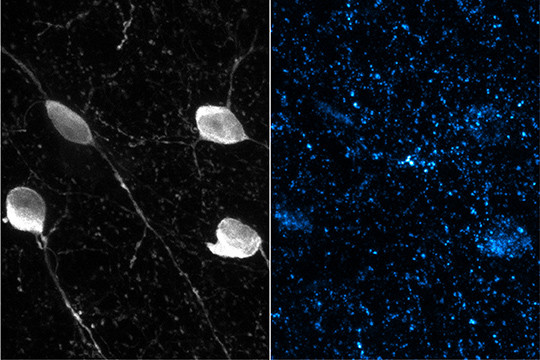
Imaging the activity of amygdala interneurons: Individual VIP+ interneurons labelled with the indicator for calcium imaging (left) and corresponding antibody staining of the peptide VIP (right).
How does the brain control the mechanisms of memory so that it only remembers major events in a constantly changing environment? The group of Andreas Lüthi has now described a fundamental neuronal microcircuit that allows mice to learn about unexpected important events and adapt their behavior accordingly. In daily life, our brain constantly receives sensory information from our environment, yet we will only remember a small fraction of it. Why do we recall certain experiences of our lives but forget about others' Powerful triggers for memory formation are both pleasant and aversive events, which produce powerful emotional responses. For example, some of the earliest memories from our childhood might include our first ice cream on a sunny day at the beach, or the neighbor's vicious dog frightening us through the fence. But how exactly can our brains translate important experiences into neural signals to trigger memory formation? A key structure for emotional memory in the brain is the amygdala. This brain region mainly consists of principal neurons, which are considered to be the main site of plasticity during learning. However, a minority of interneurons can powerfully inhibit the activity of principal neurons and therefore play an important role in local information processing in the brain.
TO READ THIS ARTICLE, CREATE YOUR ACCOUNT
And extend your reading, free of charge and with no commitment.