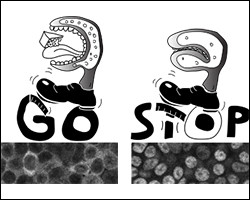
In well-being nutritional conditions (left), lysosomal signaling inactivates Tfe3 and licenses differentiation (bottom left). If energy sources are limited (right), Tfe3 is active and blocks developmental progression (bottom right).
Upon exit from self-renewal, embryonic stem cells differentiate into different types of tissues - a process regulated by various complex mechanisms. Recent work published by the Betschinger group shows the importance of the lysosome - which is directly associated with cellular metabolism and nutrition - in developmental progression. The researchers could also link their findings to a human developmental disorder. At an early stage of development, a small number of cells in the embryo acquires the ability to generate all cell types of the adult animal. This property is called pluripotency and captured in self-renewing embryonic stem cells (ESCs). How pluripotent cells lose their identity and differentiate into specialized tissues is not well understood. Florian Villegas, a PhD student in the Betschinger group, and collaborators wanted to know more about this process.
TO READ THIS ARTICLE, CREATE YOUR ACCOUNT
And extend your reading, free of charge and with no commitment.