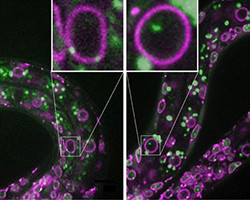
Live microscopy of a C. elegans L1 larva with the nuclear envelope labelled in purple and a heterochromatic domain tagged in green.
May 22, 2019 From yeast to man, the genome is partitioned into subnuclear compartments, with active euchromatin spatially separated from silent heterochromatin, which is often found at the nuclear periphery. This spatial distribution correlates with gene expression and contributes to cell-type integrity. In a study published in Nature, the Gasser group showed that the sequestration of a strong gene activator, CBP/p300, regulates the spatial organization of inactive domains. In addition to the local structure of chromatin is a level of gene control based on the spatial separation of active from inactive chromatin domains within the nucleus. The 3D organization of euchromatic (active) and heterochromatic (inactive) genes helps stabilize cell fate choices. This characteristic organization of the genome is robust, yet it is also flexible: some genomic sequences shift from euchromatic to heterochromatic compartments, and vice versa, during development or in response to the environment. The principles that govern chromatin segregation appear to be universal, and are based on post-translational modifications of proteins that organize DNA.
TO READ THIS ARTICLE, CREATE YOUR ACCOUNT
And extend your reading, free of charge and with no commitment.