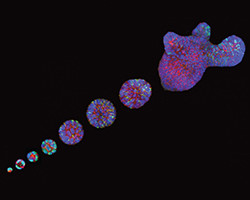
From a single stem cell to a fully-grown intestinal organoid Captions pictures below: 1: Symmetry-breaking in intestinal organoid 2-3: Fully-grown intestinal organoids
April 25, 2019 Intestinal organoids are three-dimensional structures derived from a single intestinal stem cell. They are great tools for applications ranging from fundamental biology to personalized and regenerative medicine. However, despite their relevance in research, it is still unclear how a single cell can give rise to a fully formed organoid. In a study published in Nature, the group of Prisca Liberali discovered the molecular events that lead to symmetry breaking - the most crucial step in organoid development. Organoids are complex three-dimensional structures that contain multiple cell types, spatially arranged similarly to the cells in a specific tissue or organ. Researchers have been developing organoids for at least 60 years, initially to explore basic mechanisms of development. However, it's only in the past decade that, thanks to improved knowledge of mammalian development and growing experience in stem cell culture, they have been able to use the self-organizing properties of stem cells to create realistic in vitro models of human tissues.
TO READ THIS ARTICLE, CREATE YOUR ACCOUNT
And extend your reading, free of charge and with no commitment.