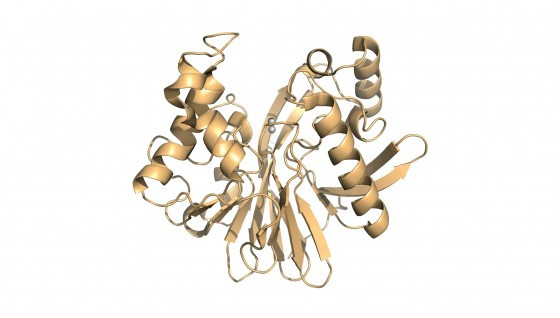
 Model of the enzyme that the researchers investigated in their study. The two grey spheres represent the active centre that binds to the pesticide to cleave it.
How do bacteria manage to adapt to synthetic environmental toxins and, for example, to even develop strategies for using a pesticide and chemical warfare agent as food within less than 70 years' The evolutionary adaptations underlying such processes have now been studied in detail by an international team of researchers. The scientists looked at an enzyme that they had isolated from bacteria that had been exposed to pesticides in the vicinity of factories producing these pesticides. Using a novel combination of methods, the researchers found out which mutations had occurred in the gene over the years - and how these mutations led to biochemical changes that now enable the enzyme to cleave the pesticide. "With our study, we show that the technique of the so-called ancestral reconstruction can not only be used to decipher evolutionary processes that date back many centuries, but also to investigate recent adaptations with very rapid evolution, such as those occurring in bacteria," emphasizes co-author Prof. Erich Bornberg-Bauer of the University of Münster, whose group was significantly involved in the study. The study was carried out in cooperation with the research group led by Prof. Nobuhiko Tokuriki from British Columbia University in Vancouver, Canada. Among other things, the results could help to find new ways to break down and dispose of environmental toxins and chemical substances. The study was published in the journal "Nature Chemical Biology".
TO READ THIS ARTICLE, CREATE YOUR ACCOUNT
And extend your reading, free of charge and with no commitment.
Your Benefits
- Access to all content
- Receive newsmails for news and jobs
- Post ads