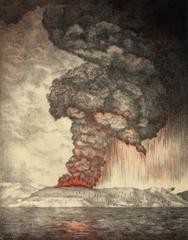
In the short period between 1808 and 1835 five large volcanic eruptions occurred in the tropics. This had a profound effect on the global climate. Credit: Wikimedia
Five large volcanic eruptions occurred in the early 19th century. They caused cooling and - as a study led by the University of Bern shows - to drying in the monsoon regions and glaciers growing in the Alps. The study shows that the pre-industrial climate was not constant: if one takes this cold period as the starting point for current global warming, the climate has already warmed up more than assumed in the current discussions. The volcanoes in the tropics went crazy between 1808 and 1835: Not only did Tambora erupt in Indonesia during this short period of time but there were also four other large eruptions. This unusual series of volcanic eruptions caused long-lasting droughts in Africa and contributed to the last advance of Alpine glaciers during the Little Ice Age. "Frequent volcanic eruptions caused an actual gear shift in the global climate system," says Stefan Brönnimann, head of the international research team that discovered the effects of the series of eruptions on the oceans and thus on atmospheric circulation. Brönnimann is Professor of Climatology at the University of Bern and a member of the Oeschger Centre for Climate Research.
TO READ THIS ARTICLE, CREATE YOUR ACCOUNT
And extend your reading, free of charge and with no commitment.