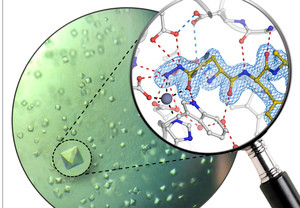
Protein crystals of the human enzyme glutaminyl cyclase and atomic structure of the new inhibitor Photo: Lisa-Marie Funk
Protein crystals of the human enzyme glutaminyl cyclase and atomic structure of the new inhibitor Photo: Lisa-Marie Funk Research team from Göttingen and Halle develops new inhibitors for enzymes With over 1.2 million people affected in Germany alone and over 50 million people worldwide, Alzheimer's disease, also referred to simply as Alzheimer's, is one of the greatest medical and social challenges of our time. Due to pathological changes in the brain, patients become increasingly forgetful and disoriented as the disease progresses. In the worst cases, even close relatives are no longer recognized and simple household tasks can no longer be carried out independently. This means care is needed for those affected. Despite intensive research, Alzheimer's disease is still considered incurable today. Researchers at the University of Göttingen and the Fraunhofer Institute for Cell Therapy and Immunology Leipzig-Halle have described a promising approach to treating Alzheimer's disease. The results have been published in the journal Biochemistry.
TO READ THIS ARTICLE, CREATE YOUR ACCOUNT
And extend your reading, free of charge and with no commitment.