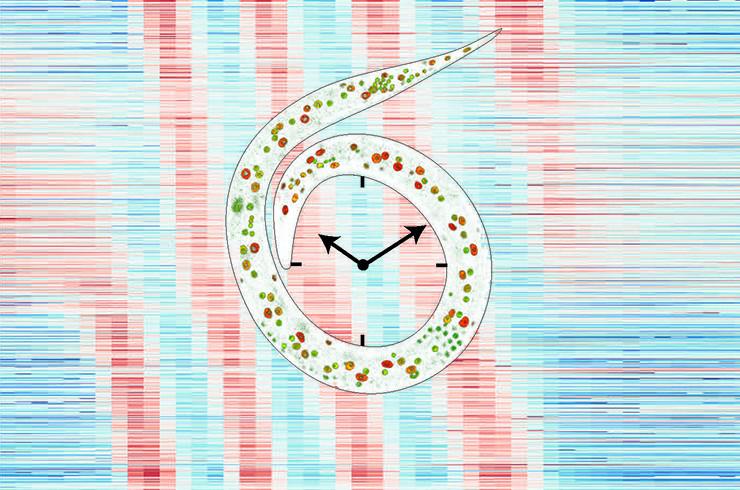
C. elegans larva on a gene expression heatmap of the oscillating genes
C. elegans larva on a gene expression heatmap of the oscillating genes The group of Helge Grosshans characterized the " C. elegans oscillator", over 3,700 genes that are rhythmically expressed during the larval development of C. elegans . They demonstrated the coupling of the oscillator with molting and got insights into how it is wired. Their findings suggest that the oscillator functions as a developmental clock with a developmental checkpoint function. Gene expression oscillations - meaning the rhythmic expression of genes - occur in many biological systems. They are well-suited for time-keeping, acting as 'molecular clocks' that control repetitive processes. For example, gene expression oscillations underlie the circadian clocks that regulate the daily sleep-wake cycle of animals. 'Developmental clocks' similarly utilize gene expression oscillations to synchronize processes in tissue and organ development.
TO READ THIS ARTICLE, CREATE YOUR ACCOUNT
And extend your reading, free of charge and with no commitment.