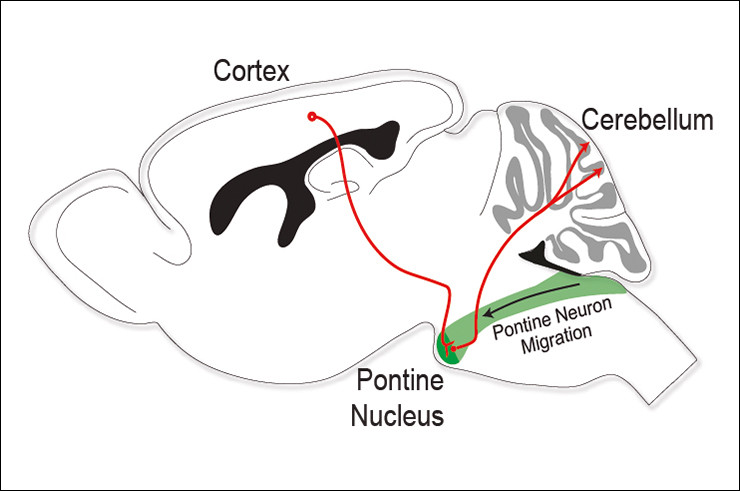
The corticocerebellar pathway
The corticocerebellar pathway - In a comprehensive study, researchers from the Rijli group found that a single Hox transcription factor expressed in a group of neurons of the pontine nucleus - the cerebral cortex most important brainstem relay to the cerebellum - determines the wiring onto these neurons of somatosensory cortical neurons, while avoiding visual cortical neurons. These findings further our understanding of the molecular logic underlying complex corticocerebellar circuit assembly. As the foundation for our brain is laid, 100 billion neurons are formed and appropriately connected. Soon after the neurons are born, they begin their migration to their final location in the brain - sometimes very far away from their birthplace - where they start establishing connections with other neurons. Together, these connections create neural circuits along which the information will travel. Coordination among these processes is critical, especially when distant brain structures need to be orderly connected through intermediate structures. The mammalian corticocerebellar pathway is one such long-distant circuit and it has a fundamental role in sensorimotor coordination and learning.
TO READ THIS ARTICLE, CREATE YOUR ACCOUNT
And extend your reading, free of charge and with no commitment.